Calculate the truck route
Add all route points so LogicCalc can identify the route countries and the distance driven in each one.

Estimate truck and HGV toll costs for a European road route. LogicCalc classifies route segments, applies supported country and special-facility toll rules for the selected vehicle, and shows tollable versus Not classified distance before the estimate enters route economics.
European HGV tolls vary by country, road network, vehicle class and current tariff rules. LogicCalc evaluates the calculated route against supported toll networks and tariff logic. Segments that cannot be classified confidently remain Not classified instead of being silently treated as free.
Add all route points so LogicCalc can identify the route countries and the distance driven in each one.
LogicCalc checks route geometry and available road metadata against supported toll networks so chargeable sections can be separated from known-free and Not classified distance.
Use the selected fleet profile and supported tariff rules to estimate the charge. Review country and facility details, then override the final amount when an authoritative route-specific value is available.
Estimated truck toll = matched tollable sections and fixed facilities evaluated with supported vehicle and tariff rules; uncertain distance remains Not classified
Real truck toll charges can depend on far more than distance, so the estimate should remain transparent and easy to replace with an official route-specific amount.
The corridor determines which national charging systems and special road sections can affect the trip.
Vehicle category, mass, axles and emissions class can influence real toll tariffs depending on the country.
LogicCalc classifies route sections against supported national toll networks instead of applying one generic Europe-wide rate to every kilometre.
Supported bridges, tunnels and fixed-charge facilities can be handled separately from kilometre-based toll roads; anything uncertain remains visible for review.
Review tollable and Not classified distance together with country or facility charges before using the estimate in route economics or a customer quote.
Keep estimated tolls visible separately and decide whether they are added to the final freight price.
Assume a truck route crosses Austria, Germany and France. LogicCalc first classifies supported tollable road sections, then evaluates the matched segments with the applicable vehicle and tariff logic available to the estimator.
Special facilities can appear separately from kilometre-based toll roads. Any uncertain part of the route remains Not classified, and the final estimate can still be replaced when an official toll portal or onboard unit provides a better figure.
| Truck toll component | Example estimate |
|---|---|
| Austria route segment | €84.00 |
| Germany route segment | €62.00 |
| France route segment | €96.00 |
| Special road charge | €38.00 |
| Estimated total truck toll | €280.00 |
Illustrative estimate only. Official toll portals, onboard units and current route-specific tariff data remain the authoritative source.
HGV tolls can materially change the economics of a cross-border movement and should remain visible in the calculation.
A country breakdown is easier to review than one unexplained European toll amount.
Use a manual override when an official portal, onboard unit or carrier-specific source provides a more precise route amount.
Keep tolls separate for internal review and decide whether they are absorbed or added to the customer price.
No. LogicCalc provides a planning estimate from supported route-network classification, vehicle data and tariff logic. Official toll operators, onboard units and booking systems remain authoritative for the final charge.
Vehicle mass, axle count, emissions class, category and national charging rules can change the applicable tariff.
Yes. The final toll value can be overridden when you have a better route-specific figure from an authoritative source.
Yes. The toll estimate can remain visible for internal planning while a separate setting controls whether it enters the final customer price.
This is a real LogicCalc workspace view. Use your own route, cargo, fleet and commercial settings for the actual calculation.
Open LogicCalc →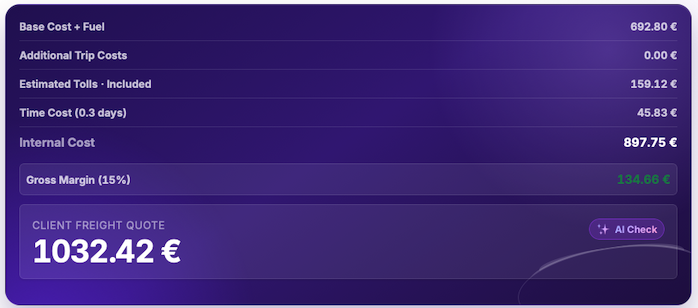
A cross-border route can move through several completely different toll systems. The useful comparison is not a single average €/km number, but the combination of chargeable network, vehicle rules and special facilities in each country.
Use the loading, delivery and intermediate points so the country sequence and route geometry reflect the actual trip.
Review which distance is matched to supported toll networks, which is known free and which remains Not classified.
Use the country and facility breakdown to see where toll exposure changes the economics of the route.
European truck toll total = country and facility charges from supported route classifications; uncertain sections stay visible as Not classified rather than being assumed free
European road charging is fragmented. The same 40-tonne truck can face kilometre charging in one country, concession motorway pricing in another and separate fixed charges for a tunnel or bridge on the same trip.
Some systems cover broad motorway or national-road networks, while others charge only specific concession roads or facilities.
Mass, axle count, Euro standard and CO₂ class can change the applicable charge where the national system differentiates by vehicle.
Distance-based tolls, concession pricing and time-based charges should not be flattened into one generic European rate.
Tunnels, bridges and Alpine or urban facilities can add fixed or section-specific charges outside the normal road tariff.
Two routes between the same cities can create different country mileage and different toll exposure.
Not classified distance remains explicit so a missing match is not presented as a free road.
Imagine a route that crosses Germany, Austria and France. The route may contain kilometre-based HGV charging, special sections and concession motorway segments in the same calculation.
Instead of multiplying the whole European distance by one rate, LogicCalc separates the countries and supported toll facilities, then leaves any uncertain distance visible for manual review.
| Item | What to review |
|---|---|
| Kilometre-based country segment | Vehicle and tariff class |
| Concession motorway segment | Route-specific section charge |
| Bridge or tunnel | Fixed or special tariff |
| Not classified distance | Manual review required |
| Final route estimate | Country + facility total |
Planning guidance only. Verify current official tariffs, toll obligations and route-specific charges before dispatch or billing.
A single expensive toll country or special facility can materially change the result of an otherwise similar route.
A country breakdown is easier to defend internally than an unexplained toll lump sum.
Country and toll exposure can change when the selected route changes, even if total distance is similar.
Visible Not classified distance tells you where an official portal or manual check is still worth doing.
No. European HGV toll systems differ by country, network, charging model and vehicle classification.
No. Route choice also depends on total distance, driving time, fuel, restrictions and operating cost, not toll alone.
It means LogicCalc could not confidently classify that route distance as supported tollable or known free. It is shown explicitly instead of being treated as zero-cost distance.
Country averages can be useful for rough planning, but route-specific tollable sections and special facilities are safer for a real freight quote.
LogicCalc Toll Intelligence uses official tariff publications and operator/government sources, then applies them to the route and vehicle profile. This page shows the sources behind the estimate and where route matching is still an approximation.
Rates come from official toll operators, government portals and legal tariff publications stored in the versioned TollTariffCatalog.
The route is matched conservatively to known toll roads and special facilities. Unknown segments stay unmatched instead of receiving an invented average country rate.
Mass, axle count, EURO class, CO₂ class, road class, special sections and currency conversion are applied where the official system requires them.
LogicCalc separates confidently matched toll roads from known non-toll segments and from road data that cannot yet be classified with sufficient confidence.
The route segment was matched to supported toll infrastructure and an applicable official tariff rule was found for the selected vehicle profile.
The matcher can positively identify the segment as outside the applicable toll network. No road toll is added for that distance.
LogicCalc does not have enough confidence to label the segment tolled or free. It may include actually free roads, urban or suburban approaches, local connectors, access sections, or route metadata that is not detailed enough for an official network match.
Official tariffs are applied to the route and vehicle profile, but exact plazas, operator contracts, discounts, subscriptions and some section-level details can still differ from the final operator invoice.
Open a country to see the exact publication or operator page currently referenced by LogicCalc.

Official HGV rates valid from 1 January 2026; prices exclude 20% VAT.
Official A12 Unterinntal and A9/A10/A11/A13/S16 HGV section tariffs. LogicCalc adds route-level section premiums so the ordinary GO kilometres are not charged twice.

Rates effective since 1 July 2024; checked against the live 2026 Toll Collect page.
Zero-emission vehicles above 4.25 t are toll-free through 30 June 2031.

Official 2026 kilometre toll rates, including the published temporary discount period where applicable.

Rates effective from 1 July 2026. Wallonia is published excluding VAT; Flanders and Brussels are not subject to VAT.

Official e-TOLL table for A/S toll roads, effective 1 February 2026.
Official e-TOLL table for G/GP toll roads, effective 1 February 2026.

Official 2026 HGV toll rates in CZK/km. LogicCalc route-ref matching is conservative; statutory section geometry remains the precision layer.

Official gross HUF/km rates. LogicCalc uses the published interurban air/noise component where exact suburban/interurban zoning is not available.

Official EUR/km rates excluding VAT, applicable from 1 July 2025 and current in 2026. LogicCalc base matching enables D/R road refs; exact prescribed section boundaries remain pending.

Official DarsGo infrastructure tariff, EUR excluding VAT. LogicCalc derives a route estimate from official section tariff data until exact section matching is available.
Official external-cost EUR/km table. LogicCalc currently uses the interurban value as a conservative baseline where exact zoning is unavailable.
Current legal Karavanke tunnel toll for DarsGo vehicle classes; amounts are published excluding 22% VAT.

SEITT tariffs increase 2% in 2026. Exact plaza matrices and the night-time free period remain route/time-specific.
Official 2026 AP-8/AP-1 matrix, VAT included. LogicCalc uses road-specific route-proportional heavy-vehicle baselines until exact toll-station IDs are available.

Official Portuguese 2026 section lengths and Class 2/3/4 tolls, VAT included. LogicCalc stores road-specific effective route rates; exact entry/exit and official journey rounding remain the next precision layer.

Official 2026 Eurovignette tariff table. LogicCalc uses the daily calendar-day tariff when existing longer-period vignette ownership is unknown.

Official APRR 2026 entry/exit matrix, prices including tax. Route-proportional estimates use published tariff relations; exact toll-station matching remains the target model.
Official SANEF 2026 tariff matrix. LogicCalc uses corridor-specific published relations rather than a generic France rate.
Official 2026 principal-journey tariffs used for road-specific route-proportional baselines.
Official ATMB 2026 Class 3/4 toll relations, VAT included.
Official France-side one-way HGV prices. Return-trip/subscription discounts are not assumed.
Official France-side one-way HGV prices; vehicle emission restrictions apply.
Official 2026 open-toll tariff per barrier for the A63 concession, differentiated by vehicle class and emissions.

Current one-off Dart Charge. Charged 06:00–22:00; journeys 22:00–06:00 are free. LogicCalc uses the one-off rate when account/pre-pay status is unknown.
Official standard pay-as-you-drive prices including VAT. LogicCalc applies the full three-zone tariff when the route explicitly identifies M6 Toll; partial-zone pricing needs exact junction matching.

Official 2026 ASPI flat/mountain unit tariffs. LogicCalc adds the ANAS component and VAT; exact concession transitions and final journey rounding remain the precision layer.
Official 2026 unit tariffs including VAT and ANAS component. LogicCalc separates the two A4 tariff zones spatially.
Official ITP flat tariffs valid through 2026, including VAT and ANAS component.
Official SAV 2026 mountain unit tariffs including VAT and ANAS component.
Official Italy-side one-way HGV prices including 22% VAT; return/subscription discounts are not assumed.
Official Italy-side one-way HGV prices including 22% VAT; emission restrictions apply.

Official entry/exit tariffs, VAT included. LogicCalc converts selected full-corridor relations into road-specific route-proportional estimates until exact toll-plaza entry/exit IDs are available.
Official AZM matrix, VAT included.
Official Bina-Istra tariff source. LogicCalc uses current A8/A9 corridor relations as route-proportional estimates until exact toll-plaza matching is available.

Official closed-system tariff matrix valid from 1 July 2026. LogicCalc uses published K3/K4 corridor relations until toll-station entry/exit identifiers are emitted by routing.

Current HGV daily rovinieta amounts are used through 30 September 2026. TollRo starts on 1 October 2026 under the current transition law.
Official RON/km TollRo rates including VAT. LogicCalc activates the distance rules only from their legal applicability date.
Published bridge/crossing tariffs in RON, added separately when the route physically crosses the facility.

Official EUR/km rates effective 1 June 2026 for motorway, Class-I and Class-II paid infrastructure, differentiated by CO₂ class, EURO class, mass and axle count.
Official pre-June 2026 tariff retained in the versioned catalogue for historical travel dates.

Official DKK/km KmToll tariff. Liability and rate use the towing vehicle's technically permissible maximum weight; LEZ supplements are handled where applicable.
Current standard no-discount truck price used when vehicle length and business/green-discount agreement status are not supplied to Toll Intelligence.
Ordinary public toll-station price used when no business agreement is known; contract/business prices can be lower.

Official LSVA/HVC rates current in 2026. The charge depends on distance, assessed weight and emission category; zero-emission electric/fuel-cell goods vehicles remain exempt in 2026.
These links explain where LogicCalc obtains tariff data. Estimated Toll remains a planning estimate: exact entry/exit plazas, discounts, subscriptions, onboard-unit contracts, time windows and operator-specific rounding can change the final invoice.
Explore route planning, transport pricing, cargo, driver-time and sustainability tools in one connected workspace.
Calculate the route, review the country toll breakdown and replace the planning estimate whenever a confirmed route-specific amount is available.
Truck toll results are planning estimates, not official tariff quotations. Verify current rates, chargeable road sections, vehicle category, mass, emission class, axles and required onboard equipment with authoritative toll sources.